
Methodology
From candidate signal to recruiter judgment.
A disciplined methodology for comparing candidates before interviews or client presentation—with consistent criteria, visible evidence, and human review at every stage.
The methodological position
A score is a signal. It is not the decision.
Assessment results become useful when they are interpreted inside a real assignment. The role, the client’s priorities, the candidate’s experience, and the interview all affect what the evidence means.
Our method gives agencies a consistent comparison layer before the interview. It does not claim to capture the whole person, and it does not remove the recruiter’s responsibility to review, question, and contextualize the result.
The method, end to end
Five stages. One accountable decision process.
The platform structures the middle of the process. The agency owns the context at the beginning and the professional recommendation at the end.
Frame the assignment
The recruiter defines the role, client context, and the decision the shortlist needs to support. Assessment evidence is interpreted inside that assignment—not as a universal ranking of people.
Recruiter sets the contextUse consistent criteria
Candidates for the same role complete a structured assessment process so the agency can compare signals on a common basis before the interview.
Platform structures the comparisonOrganize the evidence
Results are translated into role-relevant strengths, evidence points, and caution areas. The aim is to make the reasoning visible—not hide it behind one headline score.
Evidence stays inspectableTurn uncertainty into questions
Areas that need more context become structured interview questions. Recruiters can verify the signal through conversation, examples, references, or work samples.
Interview validates the signalMake the professional recommendation
The recruiter weighs assessment evidence alongside role requirements, client priorities, experience, and interview performance before deciding what to present.
Human judgment remains finalFrom result to action
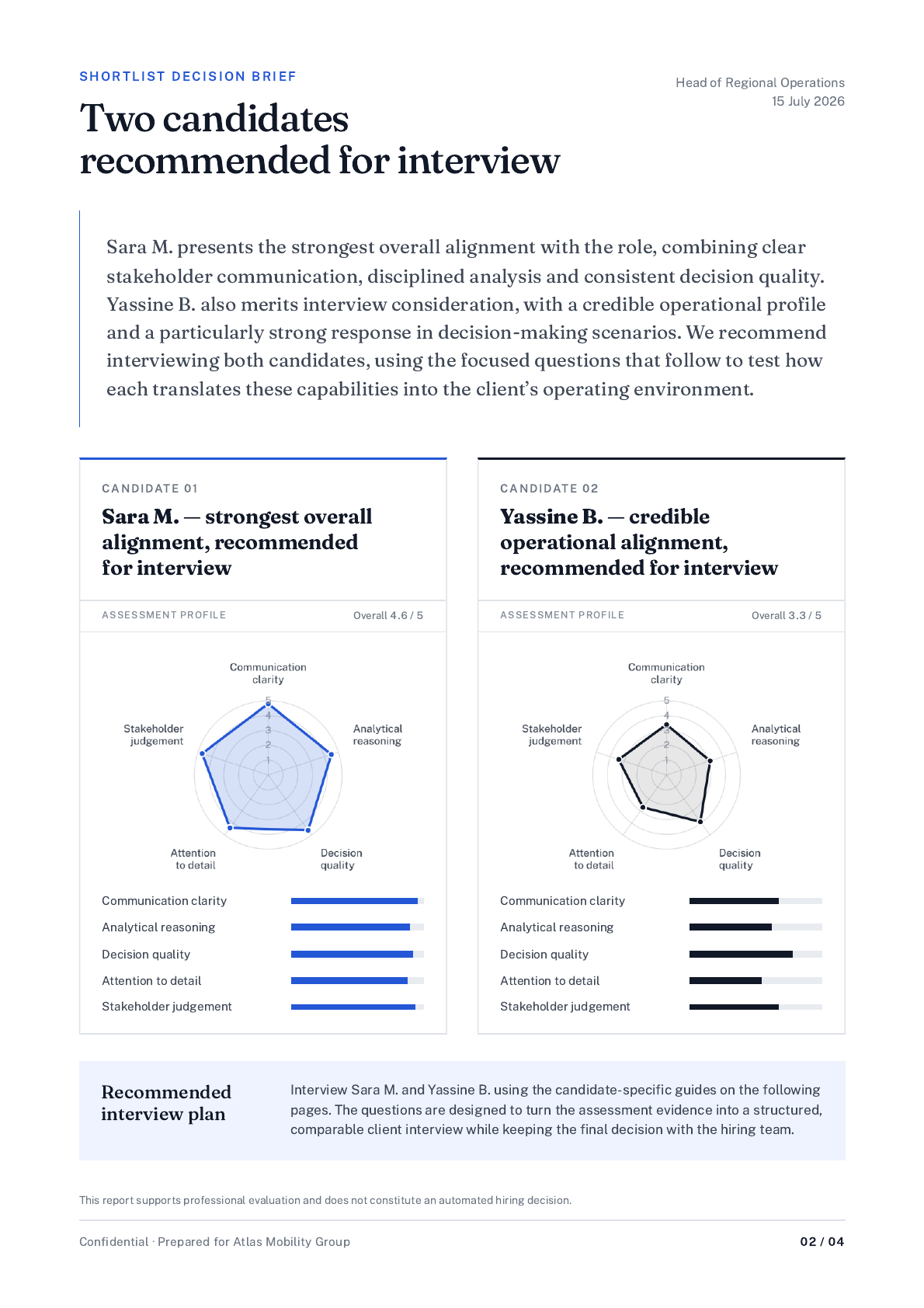
The output is built to be discussed.
A client-ready brief should show the reasoning behind a recommendation without presenting the assessment as an automatic verdict.
Comparison discipline
Useful comparison requires boundaries.
Role context
Candidates are compared for the same assignment. The output is not a universal ranking of ability or employability.
Consistent criteria
The same assessment criteria are used across the shortlist so differences can be discussed on a common basis.
Visible reasoning
Evidence, caution areas, and interview questions remain visible instead of being collapsed into a black-box recommendation.
Multiple sources
Assessment signals should be weighed alongside interviews, work history, references, work samples, and client requirements.
Proportionate language
The wording supports comparison and verification. It does not claim certainty about future performance or hiring outcomes.
Human oversight
The software supports the recruiter. It does not replace the recruiter.
IntelligencesTest organizes evidence and sharpens interview focus. Final decisions still involve recruiter judgment, role context, client needs, and candidate conversation.
The platform provides
- Comparable evidence for the same role
- Strengths and risks to verify
- Interview questions linked to assessment signals
- A client-ready structure for the agency’s recommendation
The recruiter remains responsible for
- Defining what matters for the assignment
- Reviewing context and contradictory evidence
- Conducting interviews and professional follow-up
- Deciding whom to advance or present to the client
Supporting standards
The method should be open to inspection.
These pages explain how assessments, scoring, and responsible-use boundaries are documented across the platform.
How evidence, limitations, and updates are reviewed over time.
→ 02Assessment standardsThe rules used when assessments are selected, written, and maintained.
→ 03How results are calculatedHow responses become scores, bands, and structured summaries.
→ 04Scientific foundationsThe research traditions behind the assessment approach.
→ 05Our sourcesThe source map used across the platform’s assessment domains.
→Methodology FAQ
Direct answers about the process.
The methodology makes candidate assessment signals more comparable, understandable, and useful before interviews or client presentation. It supports recruiter judgment rather than automating the hiring decision.
No. IntelligencesTest does not decide who to hire or reject. It organizes evidence, identifies areas to verify, and provides structured interview questions. The recruiter remains responsible for review and recommendation.
Role context makes comparison meaningful. Candidates for the same assignment are reviewed using the same criteria, while the recruiter keeps the client’s priorities, experience requirements, and interview evidence in view.
The recruiter reviews the resulting evidence, strengths, risks to verify, and interview questions. Those signals are then checked against interviews, references, work samples, and the context of the role before any client recommendation is made.
See it in practice
Use the method on your next real shortlist.
Start with one active role and up to 10 candidates. No credit card required.
Start free